
16 Bar Air Compressors for Laser Cutting in Malaysia: A Buyer's Guide
Choosing a 16 bar screw compressor for laser cutting takes more than matching pressure. Learn how to size air flow, specify dry air and compare complete systems.
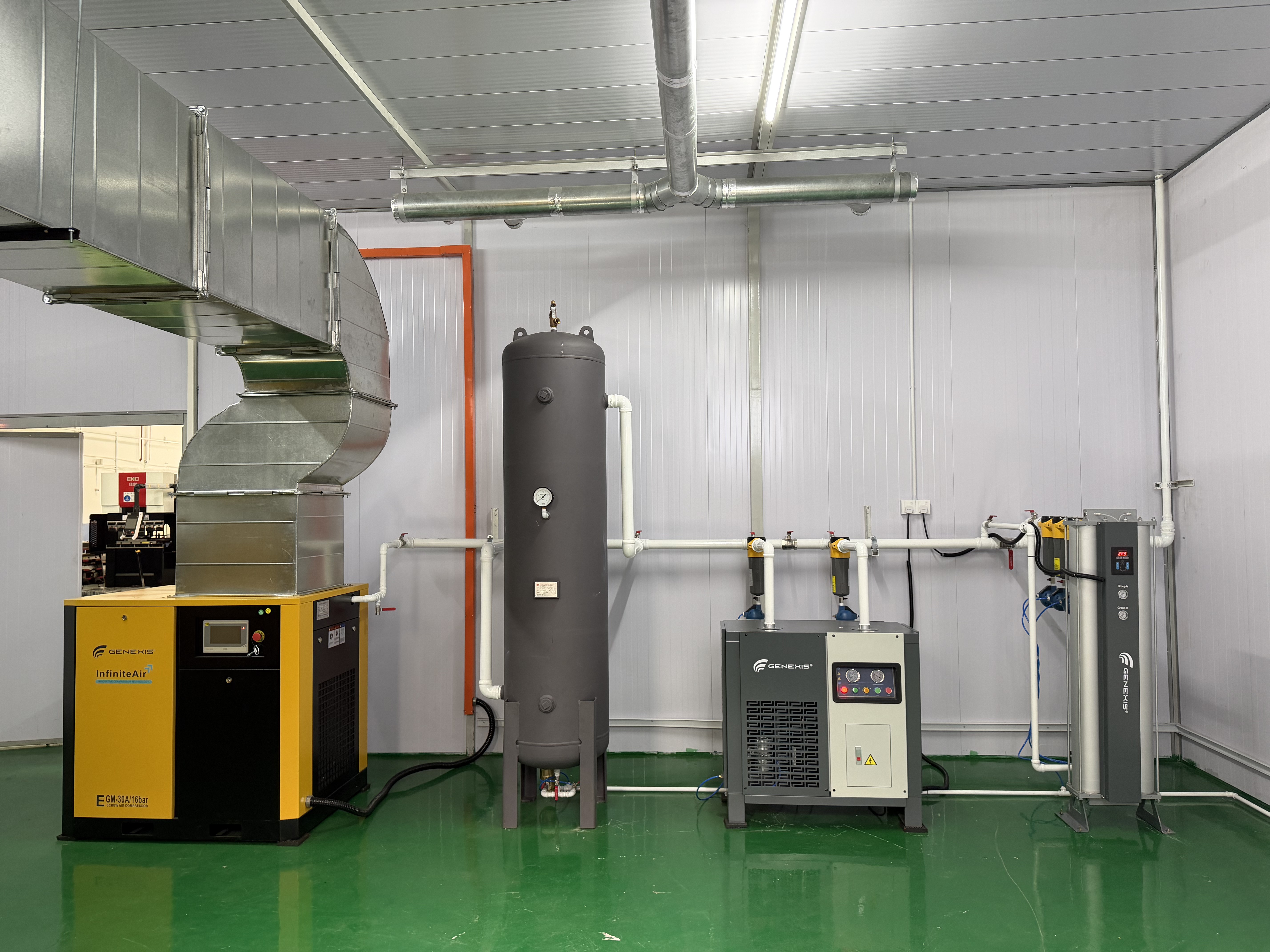
If you're buying a laser cutting machine, the compressed-air package can look like a small accessory beside the laser itself. But unstable pressure, insufficient air flow or wet air can undermine the whole installation. A compressor labelled ‘16 bar’ is only the starting point — it must deliver the right volume of suitably treated air at the machine while cutting.
This guide explains what to ask before ordering a high-pressure screw compressor in Malaysia, how to compare VSD systems, and why the dryer, filters, receiver and piping deserve as much attention as the compressor.
Why Do Some Laser Cutting Machines Need 16 Bar Air?
Some fibre laser cutting processes use compressed air as the assist gas to help remove molten material from the cut. The required pressure and flow depend on the laser manufacturer's process specification, material, thickness, nozzle and cutting parameters. A 16 bar compressor may suit some of these applications, but it is not a universal requirement for every laser.
Compressed air is not interchangeable with nitrogen or oxygen in every cutting job. Its oxygen content can affect edge oxidation and finish. Ask the laser supplier which assist gas is approved for your material and quality requirements before deciding that compressed air is the right solution.
Start with the laser machine's specification
Request the required inlet pressure, peak and continuous air consumption, air-quality specification and permitted assist gases. Confirm whether pressure is stated as gauge pressure (barg) or absolute pressure (bara), and whether flow is expressed as free-air delivery or volume at operating pressure.
16 Bar vs 8 Bar: Pressure Is Not the Same as Capacity
Most general factory compressed-air systems operate at lower pressure than a dedicated high-pressure laser-cutting system. You cannot assume that an 8 bar compressor can safely become a 16 bar machine by changing its controller setting. The compressor and every downstream component must be designed and rated for the intended operating conditions.
| What to compare | General factory system | Laser-cutting system |
|---|---|---|
| Pressure | Often around 7–8 bar; check each machine | Use the laser manufacturer's specified inlet pressure |
| Air flow | Combined demand from tools and production equipment | Peak cutting demand, simultaneous lasers and any other connected loads |
| Air treatment | Matched to the production process | Matched to the laser's moisture, oil and particle limits |
| Component ratings | Suitable for the system's maximum operating conditions | High-pressure-rated receiver, dryer, filters, drains and piping |
For a given compressor design, delivered air flow generally falls as discharge pressure rises. Compare the manufacturer's free-air delivery (FAD) at your required pressure, not the output quoted for a lower-pressure version. Two compressors with the same motor power can have different usable capacities.
How to Size a Compressor for Laser Cutting
- Obtain the laser supplier's peak and continuous air consumption for your actual cutting jobs — not just the laser's electrical power rating.
- Confirm the flow units and reference conditions so the machine demand and compressor FAD are compared on the same basis.
- Include simultaneous demand if more than one laser or other equipment will share the supply.
- Account for pressure loss through the dryer, filters, regulators and piping at peak flow.
- Include desiccant dryer purge air where applicable; this is additional demand on the compressor.
- Allow a justified margin for demand variation and planned expansion, without oversizing the machine blindly.
If the laser requires 16 bar at its inlet, a compressor that can only deliver 16 bar at its outlet may leave insufficient pressure after treatment and piping losses. Have the supplier check the complete pressure budget and select suitable equipment — do not raise a setpoint beyond the manufacturer's approved limits.
Dryers and Filters: Protecting the Cutting Process
Malaysia's warm, humid air makes condensate management important. Compression creates hot air that releases water as it cools. Without effective drying and drainage, moisture can travel into the downstream system. Specify air quality at the laser inlet, rather than assuming that adding a dryer makes the air suitable.
Refrigerated or desiccant dryer?
A refrigerated dryer may meet some applications' moisture requirements. A desiccant dryer is appropriate when the equipment needs a lower pressure dew point. The correct choice comes from the laser manufacturer's specification, the piping environment and the dryer capacity at actual pressure, temperature and flow. Neither option is automatically right for every laser.
Specify the filter train, not just the number of filters
Particle removal, coalescing filtration and any oil-vapour treatment should be selected to meet the required air-quality limits. Desiccant systems may also need downstream dust filtration. Filter grades, rated capacity, pressure loss and replacement intervals matter more than how many housings appear in the quotation. Filtration alone does not establish ISO Class 0 certification.
For the differences between dryer types and pressure dew point, read our air dryer and compressed-air moisture guide.
Receiver Tank and Piping: Rate the Whole System
The receiver helps buffer short demand peaks, but it cannot compensate for a compressor that is continuously undersized. Select its capacity and allowable pressure as part of the system design, with the applicable JKKP/DOSH documentation and inspection requirements confirmed for the installation.
- Check the allowable working pressure of the receiver, dryer, filter housings, drains, valves, hoses, fittings and regulators — not just the compressor.
- Have a qualified supplier specify pressure-relief protection and settings appropriate to the equipment ratings.
- Size piping for flow, length and permissible pressure drop; avoid unnecessary restrictions near the laser.
- Provide appropriate condensate drains, isolation points and safe maintenance access.
- Consider a dedicated high-pressure circuit rather than raising the pressure of the entire factory network.
Never uprate equipment by changing a setting
Do not modify safety valves, bypass protection or operate any component above its approved rating. Have a qualified compressed-air specialist assess existing equipment before connecting it to a high-pressure system.
Layout and pipe sizing also affect pressure at the machine. See our compressed-air piping design guide for practical planning considerations.
Is a 16 Bar VSD Compressor Worth It?
A VSD (inverter) screw compressor varies motor speed to follow demand within its operating range. It can reduce inefficient unloaded running where demand varies between cutting, positioning and idle periods. The benefit depends on the load profile, minimum flow, control strategy and the efficiency of the specific models being compared.
VSD is not a guaranteed savings percentage. A machine operating close to full load continuously may show a different result from one with frequent idle periods. Request power and flow data at the intended operating pressure and assess the dryer and other auxiliaries alongside the compressor.
Use our energy savings calculator for an indicative comparison. It is not a 16 bar sizing tool or a substitute for model-specific performance data and a site assessment.
What Should a 16 Bar System Quotation Include?
There is no single reliable price for a ‘16 bar laser compressor’. Required air flow, treatment quality, operating hours and installation conditions determine the package. Compare complete installed systems on the same specification rather than compressor-only prices.
- Compressor model, motor power, approved working pressure and FAD at that pressure.
- Receiver capacity, pressure rating, safety equipment and applicable documentation.
- Dryer type, pressure dew point, rated operating conditions and purge consumption if relevant.
- Filter grades, downstream air-quality target and pressure-loss allowance.
- Piping, electrical work, condensate management, delivery and commissioning scope.
- Warranty conditions, maintenance costs, consumables availability and local service arrangements.
- An acceptance check of pressure, flow and specified air quality at the machine under the agreed cutting conditions.
For a broader breakdown of equipment and installation costs, see Air Compressor Price in Malaysia.
A Real Genexis 16 Bar Laser-Cutting Installation
The photo above shows a Jim Services Genexis EGM-30A VSD 16 bar installation with a desiccant dryer and five filters for a laser cutting machine. It demonstrates a complete high-pressure air package, not a compressor on its own. Its configuration is an example of our work — not a recommendation that every laser needs the same model, dryer or filter arrangement.
Discuss Your Laser-Cutting Air Supply in Penang and Kedah
Jim Services has specialised in compressed-air systems since 1985. For a laser-cutting project in Penang or Kedah, send us the machine's air-demand specification, required inlet pressure, air-quality limits, number of lasers and expected operating hours. We can discuss a suitable Genexis high-pressure system and an itemised quotation covering the compressor, air treatment, receiver and installation.
Ask for a system quotation
WhatsApp Jim Services at 018-264 6199, call 04-506 0978 or email sales@jimservicesmy.com. Include your laser model and its compressed-air specification so we can assess the complete package.
Related Articles
Air Compressor Price in Malaysia: What Should You Actually Budget? (2026)
An honest breakdown of air compressor pricing in Malaysia — what drives cost, what a complete system includes, and how to compare quotes properly.
Read article: Air Compressor Price in Malaysia: What Should You Actually Budget? (2026) Buying GuidesDo You Need an Air Dryer? The Compressed Air Moisture Guide for Malaysian Factories
Why Malaysia's humidity puts water in every compressed air line — the damage it causes, refrigerated vs desiccant dryers, and how to size one correctly.
Read article: Do You Need an Air Dryer? The Compressed Air Moisture Guide for Malaysian Factories Industry InsightsCompressed Air Piping Design: Layout, Sizing & the Pressure Drop Problem
A practical piping guide for Malaysian factories — ring mains, pipe sizing, take-off points, materials and avoiding the pressure drop that costs you energy.
Read article: Compressed Air Piping Design: Layout, Sizing & the Pressure Drop ProblemReady To Talk To An Expert?
Free site survey and honest, jargon-free recommendations.