
Backup & Duty-Standby Compressors: Does Your Factory Need a Second Unit?
How duty-standby, duty-assist and rotation configurations work — and how to decide whether redundancy is worth it for your production line.
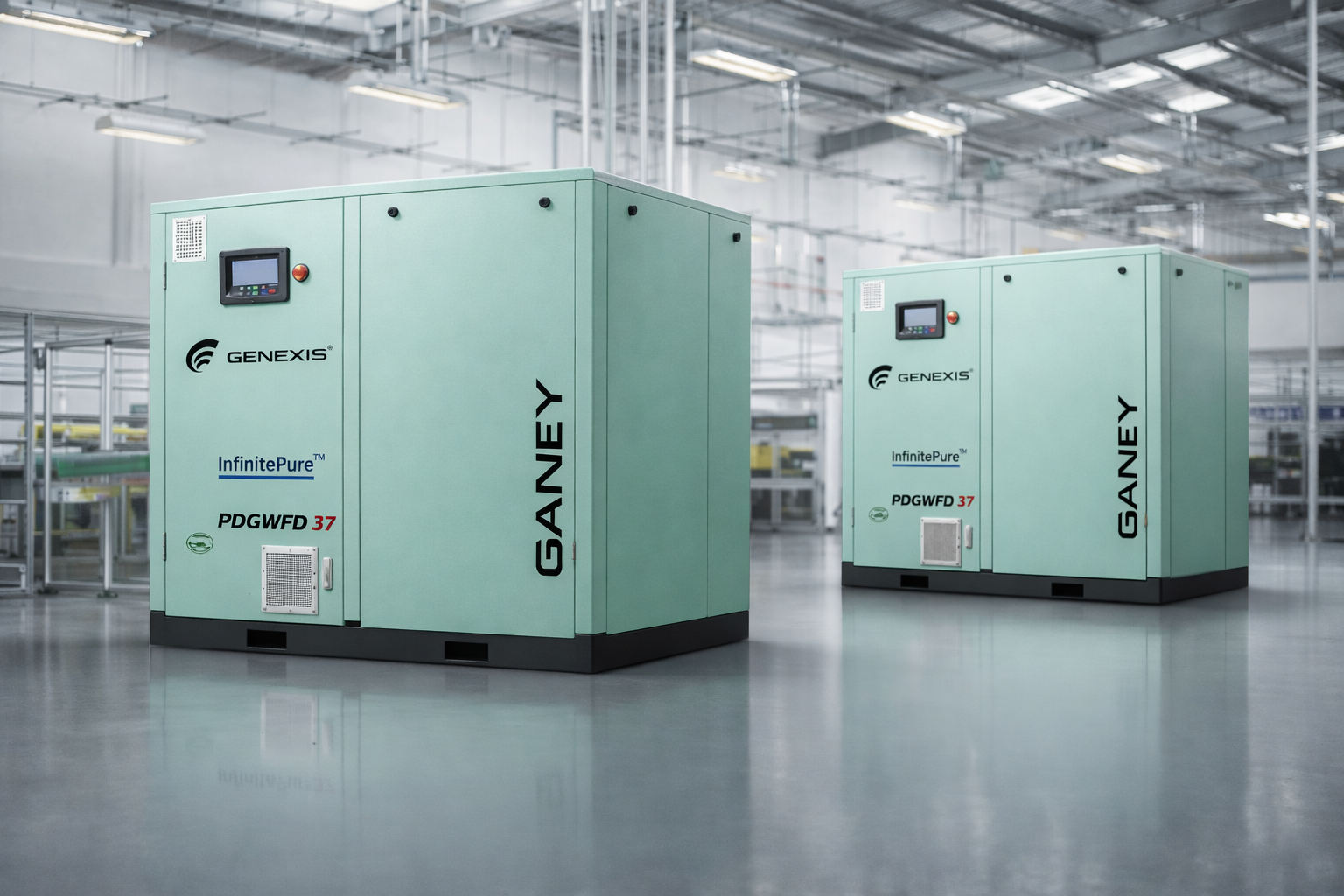
Most factories run one compressor. It works fine — right up until the day it doesn't, and the entire plant discovers that compressed air was a single point of failure all along. This guide explains how multi-compressor setups work, who genuinely needs one, and how to decide whether a second unit is an insurance policy or an unnecessary expense.
The Single Point of Failure Problem
Ask a simple question: if your compressor stopped right now, what would still be running?
In most factories the honest answer is ‘not much.’ Pneumatic tools, actuators, conveyors, packaging lines, paint booths, instrument air — all of it stops. And unlike a failed machine on one line, a compressor failure stops every line at once.
Even with excellent maintenance and a fast service response, a major failure means hours of downtime at minimum. If a part needs ordering, it can mean days.
The Common Multi-Compressor Configurations
Duty-Standby
One compressor (the duty unit) handles all production. The second (standby) sits idle and starts automatically only if the duty unit fails or is taken out for service.
- Best for: factories where downtime is unacceptable but demand fits comfortably within one machine
- Benefit: full redundancy, plus you can service the main unit during production instead of waiting for a shutdown window
Duty-Assist (Sequencing)
Both compressors are active. A lead unit handles base demand, and the second cuts in only when demand rises above what the first can supply.
- Best for: factories with variable demand or clear peak periods
- Benefit: better efficiency — you're not running one oversized machine at part load all day. Two smaller units matched to real demand often use less energy than one big one
Rotation / Alternating
Two units share the workload by alternating which one leads, typically swapping on a timer or run-hours basis.
- Best for: balancing wear so both machines age evenly rather than one wearing out while the other sits
- Benefit: longer life across both units, and both stay proven-working rather than one becoming an unreliable ‘we hope it starts’ spare
Many real installations combine these — a rotating pair that also sequences under peak load. This is a common setup in the twin-compressor rooms we build.
Who Genuinely Needs Redundancy
Strong Case for a Backup
- Continuous-process plants where stopping and restarting is itself costly or damaging
- Semiconductor, electronics and pharma where a pressure loss can ruin in-process product
- F&B production with perishable materials mid-process
- Factories with contractual delivery penalties or just-in-time obligations
- Plants where one hour of downtime costs more than the annual cost of owning a standby unit — for many mid-sized factories, that threshold is crossed easily
- Anywhere the compressor is old and reliability is already in question
Weaker Case
- Workshops and light manufacturing where a day's pause is inconvenient but not costly
- Operations with flexible schedules that can absorb a stoppage
- Sites where a rental compressor could bridge a failure acceptably
Running the Numbers
The decision comes down to one comparison:
Cost of a standby unit — purchase, installation, the floor space, plus modest maintenance (a standby unit still needs periodic running and servicing).
Versus cost of the downtime it prevents — hourly production loss × realistic hours of an unplanned outage × how often that's likely over the machine's life. Then add what you gain from being able to service the main unit without stopping production, which for many factories is worth a good share of the cost on its own.
The duty-assist configuration adds a third factor: if two right-sized machines run more efficiently than one oversized one, part of the second unit's cost comes back as energy savings every year — which changes the maths considerably.
Practical Considerations
- Sizing the standby: full redundancy means the backup can carry 100% of demand alone. Some factories accept a smaller standby that keeps only critical processes alive — cheaper, but decide deliberately which lines you're willing to lose
- Controls: proper sequencing controls handle changeover and rotation automatically. Manual changeover means someone has to be there, awake, and know what to do
- Room design: plan the space before you need it. Retro-fitting a second compressor into a room designed for one usually means compromised clearances and ventilation
- Tank and treatment capacity: the receiver, dryer and piping must handle the combined output if both units can run together
- Exercise the standby. A backup that hasn't run in eight months is not a backup. Rotation setups avoid this problem entirely
Design Your System for Uptime
We design, supply and install multi-compressor systems — duty-standby, sequencing and rotation setups — including controls, room layout and matched air treatment. Several of our twin-compressor installations across Penang and Kedah were built exactly for this reason. A free site survey will tell you whether redundancy makes financial sense for your operation, honestly.
Talk It Through with an Engineer
WhatsApp Jim Services at 018-264 6199 or call 04-506 0978. Visit No.11A, Lengkok IKS Simpang Ampat 1, Taman IKS Simpang Ampat, 14100 Simpang Ampat, Pulau Pinang.
Related Articles
Air Compressor Maintenance Schedule: What to Do Daily, Monthly & Yearly (and the Real Cost of Skipping It)
A practical preventive maintenance schedule for factory air compressors — daily, weekly, monthly and yearly tasks — plus the real cost of unplanned downtime.
Read article: Air Compressor Maintenance Schedule: What to Do Daily, Monthly & Yearly (and the Real Cost of Skipping It) Cost & ROIRepair or Replace? When It's Time to Retire Your Old Air Compressor
A practical decision framework for ageing air compressors — repair cost thresholds, hidden energy waste, and when replacement pays for itself.
Read article: Repair or Replace? When It's Time to Retire Your Old Air CompressorReady To Talk To An Expert?
Free site survey and honest, jargon-free recommendations.