
Repair or Replace? When It's Time to Retire Your Old Air Compressor
A practical decision framework for ageing air compressors — repair cost thresholds, hidden energy waste, and when replacement pays for itself.
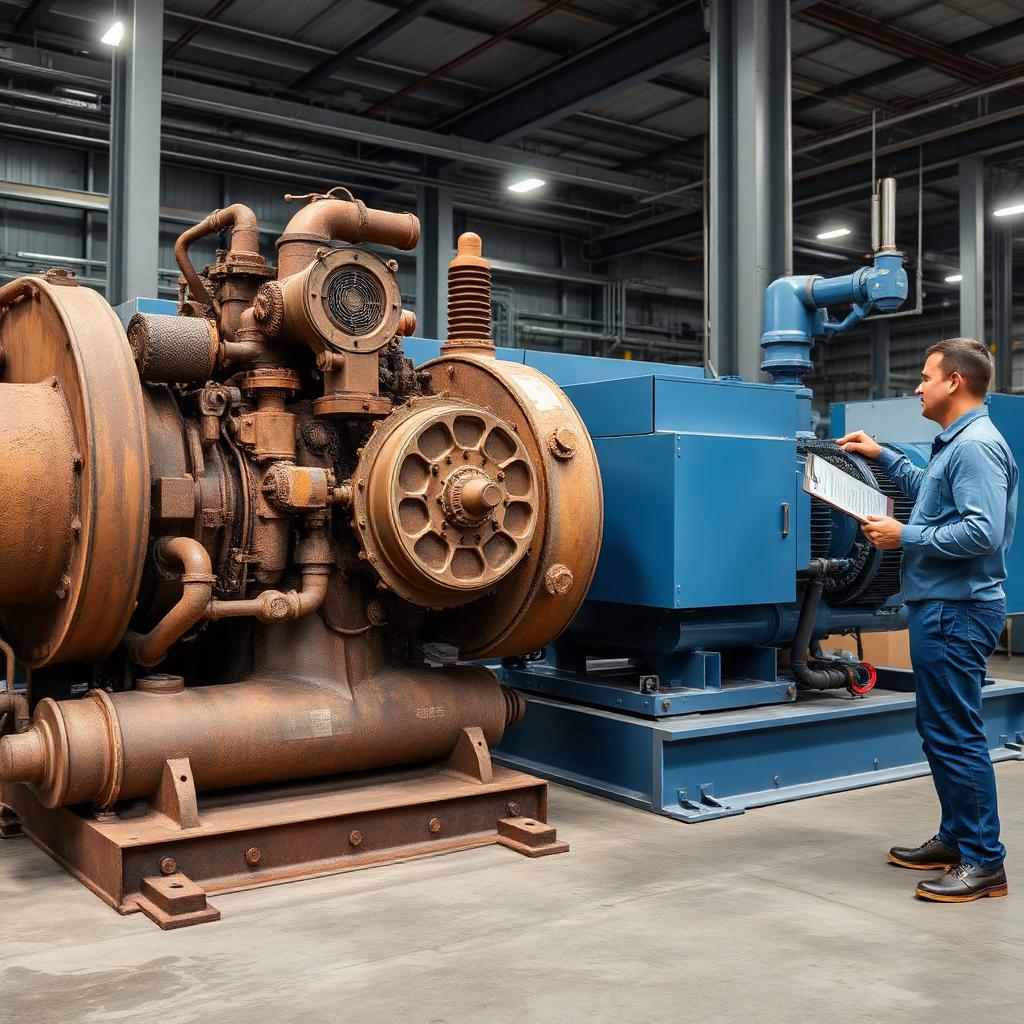
Every factory eventually faces this decision: the old compressor breaks down again, the repair quote lands on your desk, and you have to choose — fix it one more time, or finally replace it? This guide gives you a practical framework to make that call with numbers, not guesswork.
The 7 Signs Your Compressor Is Telling You It's Time
1. Repairs are getting more frequent
One breakdown is bad luck. Breakdowns every few months are a pattern — and each one costs you production time on top of the repair bill.
2. A major component has failed
When the air-end, motor or major electrical system fails on an old machine, the repair often costs a large fraction of a new unit — on a machine that will keep ageing around the new part.
3. Your electricity bill keeps climbing
Old compressors lose efficiency as they wear. Worn air-ends, tired motors and internal leakage mean you burn more electricity to produce the same air. And if your old unit is fixed-speed running on a variable load, it's wasting energy every hour — modern VSD units cut energy use by 20–35% on typical factory demand.
4. Spare parts are hard to get
When parts for a discontinued model take weeks to source — or come only from grey-market suppliers — every future breakdown becomes an extended shutdown.
5. It can't keep up with your factory anymore
If production has grown since you bought it, the compressor may be running flat-out constantly — accelerating wear and still failing to hold pressure at peak demand.
6. It no longer suits your process
Product lines change. If you've moved into work that needs cleaner, drier or oil-free air, no amount of repair fixes a fundamental mismatch.
7. Downtime is starting to cost real money
When a breakdown stops your line, the production loss usually dwarfs the repair bill. If your operation has grown less tolerant of downtime, reliability itself becomes the reason to replace.
The 50% Rule (and Why It's Only a Starting Point)
A common industry rule of thumb: if a repair costs more than 50% of the price of an equivalent new unit, replace it. It's a reasonable starting point — but it misses the two biggest factors:
- Energy — electricity is the largest lifetime cost of any compressor. An old, inefficient unit can waste more money in electricity each year than the repair bill you're agonising over. A repair that 'saves' you RM 10,000 today while the machine wastes that much annually in energy is no saving at all.
- Downtime risk — the 50% rule prices the repair, not the next failure. An ageing machine that's already failed twice this year carries a real probability of failing again, with production losses attached.
How to Actually Run the Numbers
Before deciding, put these figures side by side.
Cost of keeping the old unit (per year)
- Expected repair costs — be honest, use the last 2 years as a guide.
- Extra electricity vs a modern equivalent — an energy audit with data logging measures this precisely rather than guessing.
- Estimated downtime cost from likely failures.
- Rising maintenance frequency.
Cost of replacing
- New unit price, minus anything recoverable from the old machine.
- Installation and commissioning.
- Minus annual energy savings — often the deciding factor with VSD.
- Minus warranty coverage — repairs stop being your problem for the warranty period.
In many real cases — especially replacing an old fixed-speed unit with a correctly sized VSD compressor — the energy savings alone pay back the replacement within a few years, before counting avoided repairs and downtime.
When Repair Is Still the Right Call
Replacement isn't always the answer. Repair makes sense when:
- The machine is relatively young and this is its first significant fault.
- The failed part is minor (valves, sensors, hoses, a belt) rather than the air-end or motor.
- The unit is correctly sized and efficient for your current demand.
- Parts are readily available and the repair restores full reliability.
- Your usage is light enough that energy inefficiency barely matters.
An honest assessment weighs all of this — which is why the right first step is often an inspection, not a quotation.
Get an Honest Assessment — Not a Sales Pitch
Our engineers inspect ageing compressors and give you the real picture: what the repair costs, what the machine is wasting in energy, and whether replacement genuinely pays. Sometimes the answer is 'repair it — it's got years left.' When it isn't, we'll show you the numbers that prove it.
Book a free assessment
WhatsApp 018-264 6199 or call 04-506 0978. We're at No.11A, Lengkok IKS Simpang Ampat 1, Taman IKS Simpang Ampat, 14100 Simpang Ampat, Pulau Pinang.
Related Articles
How to Choose the Right Air Compressor for Your Factory: A Complete Buyer's Guide
The exact 7-step process our engineers use during free site surveys — from calculating CFM to evaluating total cost of ownership.
Read article: How to Choose the Right Air Compressor for Your Factory: A Complete Buyer's Guide ComparisonsVSD vs Fixed Speed Air Compressors: Which One Saves More Energy?
How each technology actually works, when to choose which, and a real Penang factory calculation showing RM 13,000+ in annual savings.
Read article: VSD vs Fixed Speed Air Compressors: Which One Saves More Energy?Ready To Talk To An Expert?
Free site survey and honest, jargon-free recommendations.