
Screw vs Piston Air Compressor: Which Is Right for Your Factory?
Screw vs piston air compressor — compare duty cycle, energy cost, air quality, noise and lifespan so you can choose the right type for your Malaysian factory.
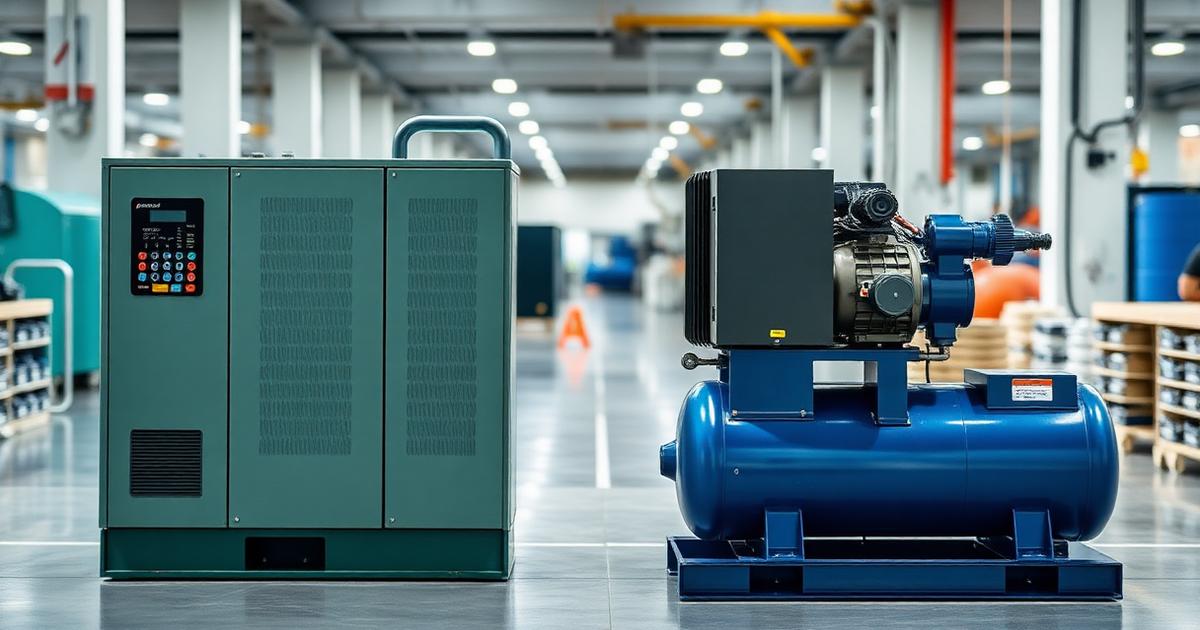
"Should I buy a screw compressor or a piston compressor?" is one of the most common questions we get during site surveys. Both produce compressed air — but they work very differently, and choosing the wrong type can mean either overspending on a unit you don't need, or buying one that burns out under the load your factory demands.
This guide breaks down the real differences in plain terms, so you can match the right technology to how your factory actually runs.
How Each Type Works
Piston (reciprocating) compressors use a piston driven by a crankshaft to compress air inside a cylinder — much like a car engine in reverse. Air is drawn in, squeezed by the piston, and pushed into a receiver tank. They build pressure in pulses.
Screw (rotary screw) compressors use two interlocking helical rotors that trap and compress air continuously as they turn. There are no pistons and no pulsing — just a smooth, constant flow of air.
That single difference — pulsed vs continuous — drives almost every other distinction below.
The Core Difference: Duty Cycle
This is the most important factor, and the one most buyers overlook.
- Piston compressors are built for intermittent use. They typically run at a 50–60% duty cycle, meaning they need to rest and cool between bursts of work. Run one continuously and it overheats, wears fast and fails early.
- Screw compressors are built for continuous use. They run at a 100% duty cycle — designed to operate all day, every shift, without stopping.
The simple rule: if your factory needs air continuously for more than a few hours at a time, you need a screw compressor. If you only need air in short bursts, a piston unit may be enough.
Side-by-Side Comparison
| Factor | Piston Compressor | Screw Compressor |
|---|---|---|
| Duty cycle | Intermittent (50–60%) | Continuous (100%) |
| Best for | Workshops, light/occasional use | Factories, production lines |
| Air delivery | Pulsed | Smooth, continuous |
| Energy efficiency | Lower at scale | Higher, especially with VSD |
| Noise & vibration | Higher | Lower |
| Air temperature | Hotter output | Cooler, more stable |
| Maintenance | More frequent | Less frequent, scheduled |
| Lifespan | Shorter under heavy load | Longer under heavy load |
| Upfront cost | Lower | Higher |
| Cost over lifetime | Higher (energy + wear) | Lower |
| Typical power range | Fractional – ~15 kW | 7.5 – 250 kW+ |
Running Cost: The Hidden Difference
The piston compressor's lower sticker price is tempting — but over a compressor's life, electricity is by far the biggest cost, not the purchase.
For a factory running multiple shifts, a screw compressor — especially a VSD (variable speed) screw compressor that adjusts motor speed to match demand — can cut energy use by 20–35% compared with running a fixed-speed or piston unit at full load. Over years of operation, that energy saving often outweighs the higher upfront price several times over.
A piston compressor running near-continuously also wears out faster, meaning more frequent repairs, more downtime and earlier replacement. For a busy factory, that's a false economy.
Air Quality Considerations
- Standard piston and screw compressors both introduce some lubricating oil into the air stream, which is fine for general factory use when paired with proper filtration.
- For electronics, semiconductor, food & beverage or pharmaceutical applications where any oil contamination is unacceptable, neither standard type is enough — you need an oil-free compressor. Water-lubricated oil-free screw compressors deliver completely clean air for these sensitive processes.
If your product can't tolerate even trace oil, air quality — not just duty cycle — should drive your decision.
Which Should You Choose?
Choose a piston compressor if:
- You run a small workshop or do occasional, light-duty work
- Air is only needed in short bursts (tyre inflation, occasional pneumatic tools)
- Budget is the primary constraint and usage is genuinely low
Choose a screw compressor if:
- You run a factory or production line that needs air for hours at a time
- You operate multiple shifts or continuous processes
- You want lower energy bills and lower lifetime cost
- You need stable, smooth, cooler air delivery
- Reliability and uptime are critical to your operation
Choose an oil-free screw compressor if:
- You're in electronics, semiconductor, F&B or pharma
- Any oil contamination would ruin your product or process
The Bottom Line for Malaysian Factories
For most industrial factories in Penang and Kedah running real production loads, a screw compressor is the right long-term choice — and a VSD screw compressor is usually the most cost-effective of all once energy savings are factored in. Piston compressors still have their place, but mainly for light, intermittent workshop use.
The safest way to decide is a proper air-demand assessment — measuring how much air you actually use, when, and at what pressure. Sizing based on a guess almost always leads to an oversized unit that wastes energy, or an undersized one that can't keep up.
Not Sure Which Type You Need?
Our engineers measure your actual air demand during a free site survey and recommend the right technology — screw, piston or oil-free — sized correctly for your factory. No oversizing, no upselling.
Talk to a specialist:
- WhatsApp: 018-264 6199
- Phone: 04-506 0978
- Address: No.11A, Lengkok IKS Simpang Ampat 1, Taman IKS Simpang Ampat, 14100 Simpang Ampat, Pulau Pinang
Related Articles
- How to Choose the Right Air Compressor for Your Factory
- VSD vs Fixed Speed Air Compressors: Which Saves More?
- Air Compressor Supplier in Penang: The Complete Local Buyer's Guide
Related Articles
How to Choose the Right Air Compressor for Your Factory: A Complete Buyer's Guide
The exact 7-step process our engineers use during free site surveys — from calculating CFM to evaluating total cost of ownership.
Read article: How to Choose the Right Air Compressor for Your Factory: A Complete Buyer's Guide ComparisonsVSD vs Fixed Speed Air Compressors: Which One Saves More Energy?
How each technology actually works, when to choose which, and a real Penang factory calculation showing RM 13,000+ in annual savings.
Read article: VSD vs Fixed Speed Air Compressors: Which One Saves More Energy?Ready To Talk To An Expert?
Free site survey and honest, jargon-free recommendations.