
Air Receiver Tank Sizing: How Big Should Your Tank Be? (A Practical Guide)
How to size an air receiver tank properly — capacity rules of thumb, why VSD and fixed-speed differ, pressure ratings, vertical vs horizontal, and the mistakes that cause short cycling.
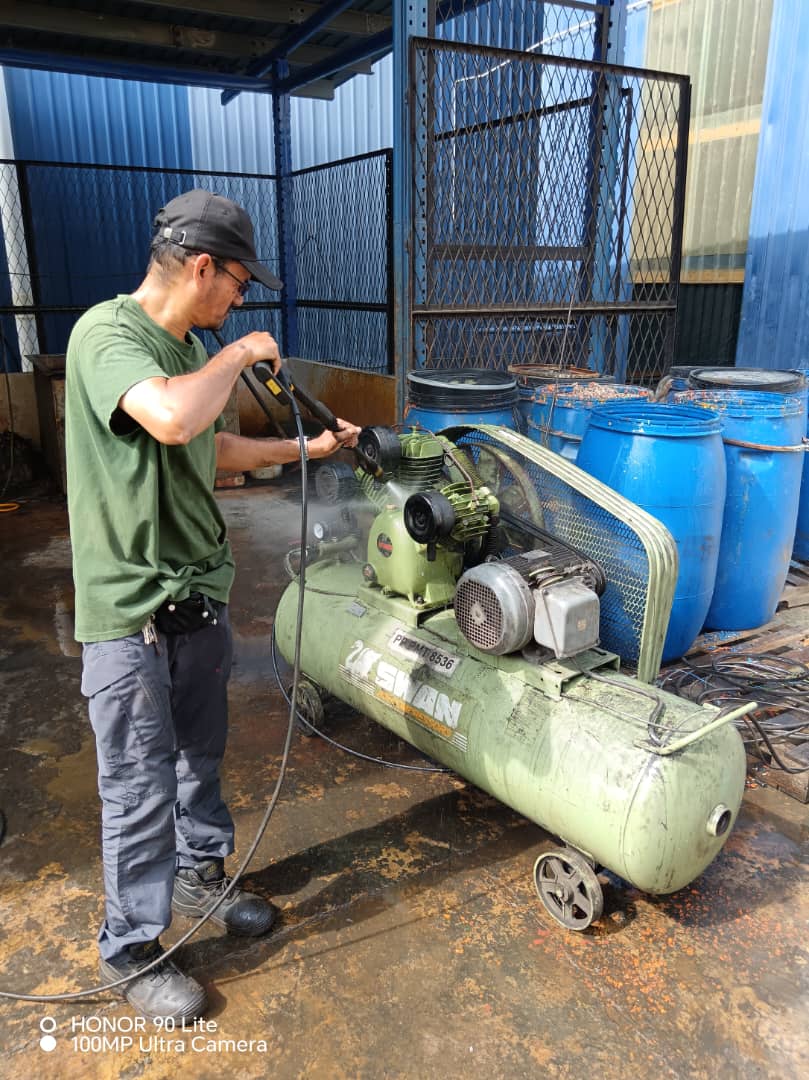
The air receiver tank is the least glamorous part of a compressed air system — and one of the most commonly mis-sized. Too small, and your compressor short-cycles itself to an early death. Too large, and you've spent money and floor space you didn't need to. This guide explains what the tank actually does, how to size one properly, and the mistakes we see most often in Malaysian factories.
What an Air Receiver Tank Actually Does
The tank isn't just storage. It performs four jobs at once:
- Buffers demand spikes — when a machine suddenly draws a burst of air, the tank supplies it instantly, without forcing the compressor to lurch into action
- Prevents short cycling — stored air means the compressor starts and stops less often, dramatically reducing motor and component wear
- Drops out water — as hot compressed air cools in the tank, much of its moisture condenses and collects at the bottom, taking load off your dryer
- Stabilises pressure — the tank smooths out pressure fluctuations, giving your tools and machines consistent supply
Get the size wrong and every one of these functions suffers.
The Rule of Thumb (and When to Ignore It)
A widely used starting point: roughly 30–50 litres of tank capacity per 1 m³/min (about 35 CFM) of compressor output — often simplified as 3–5 US gallons per CFM.
So a compressor producing around 3 m³/min would pair with roughly a 100–150 litre minimum, though in practice most factories size larger for comfort — 300 L and up is common for industrial installations.
But the rule of thumb is only a floor. Size larger than the rule suggests when:
- Your demand is spiky — intermittent heavy draws (blast cleaning, large cylinders, pulse-jet filters) need a big buffer to avoid pressure dips
- You run a fixed-speed compressor — more on this below
- You want redundancy time — a larger tank keeps critical processes supplied for precious extra seconds during a trip or switchover
Size closer to the minimum when demand is smooth and steady, or when a VSD compressor is doing the load-matching.
VSD vs Fixed-Speed: Why the Tank Size Differs
This is the nuance most sizing guides skip:
- Fixed-speed compressors rely heavily on the tank. They only have two states — loaded or unloaded — so the tank is what prevents constant start/stop cycling. Undersize the tank and the motor cycles itself to death. Fixed-speed systems need generous tanks.
- VSD compressors modulate their output to match demand, so they lean on the tank less for cycling control. They still need one — for demand spikes, moisture drop-out and pressure stability — but the sizing pressure is lower.
If you're replacing a fixed-speed unit with a VSD, your existing tank is usually still fine. Going the other way, check the tank isn't now undersized.
Pressure Rating: Match It to Your System
The tank's rated pressure must exceed your compressor's maximum output pressure — with the safety valve calibrated accordingly.
- Standard industrial systems at 7–10 bar typically use 10 barg-rated tanks
- High-pressure applications (e.g. 16 bar laser cutting systems) need 16 barg-rated tanks
- Never use a tank rated below your compressor's maximum pressure — this is a safety issue, not a preference
In Malaysia, the tank is a regulated pressure vessel: it must be JKKP (DOSH) certified, fitted with a calibrated gauge and safety valve, and periodically re-inspected. We've covered the legal side in detail in our JKKP certification guide — this article is about getting the size right; that one is about staying legal.
Vertical vs Horizontal
- Vertical tanks are the standard industrial choice — smaller footprint, and condensate collects neatly at the bottom drain. Standard sizes commonly run from 300 L up to 2,000 L, with larger and custom sizes made to order
- Horizontal tanks suit low-ceiling spaces or where the tank doubles as a mounting base for a small compressor — more common in workshop-scale setups
For most factories, vertical is the default unless the building says otherwise.
Wet Tank, Dry Tank, or Both?
Larger systems often split storage into two tanks:
- Wet tank — placed before the dryer. Receives hot air straight from the compressor, drops out the bulk of the water, protects the dryer from overload
- Dry tank — placed after the dryer. Stores clean, dry air ready for use, buffering demand without re-introducing moisture
Smaller systems typically use a single tank before the dryer. If your air demand is large or your dryer struggles on humid days, a wet/dry split is worth discussing during a site survey.
Common Sizing Mistakes We See
- Reusing an old, smaller tank with a new, bigger compressor — instant short cycling
- Ignoring demand spikes and sizing off average consumption only
- Buying uncertified tanks to save money — a legal liability the first time DOSH inspects
- No drain discipline — even a perfectly sized tank corrodes from inside if condensate sits in it (automatic drains solve this)
- Placing the tank far from spiky demand — a buffer works best near the machines that need it
Made-in-Malaysia Tanks, Sized for Your System
We're one of Malaysia's largest air receiver tank manufacturers — standard vertical tanks from 300 L to 2,000 L at 10–16 barg, with higher pressures and any custom size made to order. Every tank is JKKP certified, includes a calibrated gauge and safety valve, and typically delivers in 3–4 weeks. Our engineers size the tank as part of your whole system during a free site survey — compressor, dryer, tank and piping matched together.
Get your tank sized right
WhatsApp Jim Services Sales Team at 018-264 6199 or call 04-506 0978. Visit us at No.11A, Lengkok IKS Simpang Ampat 1, Taman IKS Simpang Ampat, 14100 Simpang Ampat, Pulau Pinang.
Frequently Asked Questions
What size air receiver tank do I need?
A common starting point is roughly 30–50 litres of tank capacity per 1 m³/min (about 35 CFM) of compressor output, or 3–5 US gallons per CFM. Most industrial installations size larger — 300 L and up — especially where demand is spiky or the compressor is fixed-speed.
Does a VSD compressor need a smaller air receiver tank?
A VSD compressor modulates output to match demand, so it relies on the tank less for cycling control and can use a smaller tank than a fixed-speed unit. It still needs a tank for demand spikes, moisture drop-out and pressure stability.
What happens if my air receiver tank is too small?
The compressor cycles on and off frequently (short cycling), which increases wear on the motor and valves, causes pressure to swing at your machines, and reduces the time available for moisture to drop out before air reaches the dryer.
Can an air receiver tank be too big?
Practically, oversizing is rarely a problem — a larger tank gives more stable pressure, better condensate separation and gentler compressor cycling. The real limits are cost, floor space and the extra time needed to pressurise the system from cold.
What pressure rating should an air receiver tank have?
The tank's rated pressure must exceed the compressor's maximum output pressure. Standard 7–10 bar systems typically use 10 barg tanks; high-pressure applications such as 16 bar laser cutting need 16 barg tanks.
Should I use a vertical or horizontal air receiver tank?
Vertical tanks are the industrial standard — smaller footprint and condensate collects at the bottom drain. Horizontal tanks suit low-ceiling spaces or where the tank doubles as a mounting base for a small compressor.
What is the difference between a wet tank and a dry tank?
A wet tank sits before the dryer and drops out the bulk of the water straight from the compressor. A dry tank sits after the dryer and stores clean, dry air for use. Larger systems often use both.
Does an air receiver tank in Malaysia need JKKP (DOSH) certification?
Yes. Air receivers are pressure vessels under Malaysian law and must be JKKP (DOSH) certified, registered and periodically inspected. Jim Services supplies tanks with JKKP certification handled as part of the installation.
How often should I drain my air receiver tank?
In Malaysia's humidity, condensate collects fast. Manual drains should be opened daily; most industrial installations fit an automatic drain and check it regularly, since a stuck-open drain wastes air and a stuck-closed one lets water build up and corrode the tank.
Related Articles
How to Choose the Right Air Compressor for Your Factory: A Complete Buyer's Guide
The exact 7-step process our engineers use during free site surveys — from calculating CFM to evaluating total cost of ownership.
Read article: How to Choose the Right Air Compressor for Your Factory: A Complete Buyer's Guide ComparisonsVSD vs Fixed Speed Air Compressors: Which One Saves More Energy?
How each technology actually works, when to choose which, and a real Penang factory calculation showing RM 13,000+ in annual savings.
Read article: VSD vs Fixed Speed Air Compressors: Which One Saves More Energy?Ready To Talk To An Expert?
Free site survey and honest, jargon-free recommendations.